Understanding Battery Assembly Line and
How Patil Automation Limited can help you?
What Is a Battery Assembly Line?
A Battery Assembly Line is a sequence of interconnected manufacturing, inspection, assembly and testing processes used to transform individual battery cells into a finished battery system.
Depending on the product architecture, production capacity and level of automation, a battery assembly line can include:
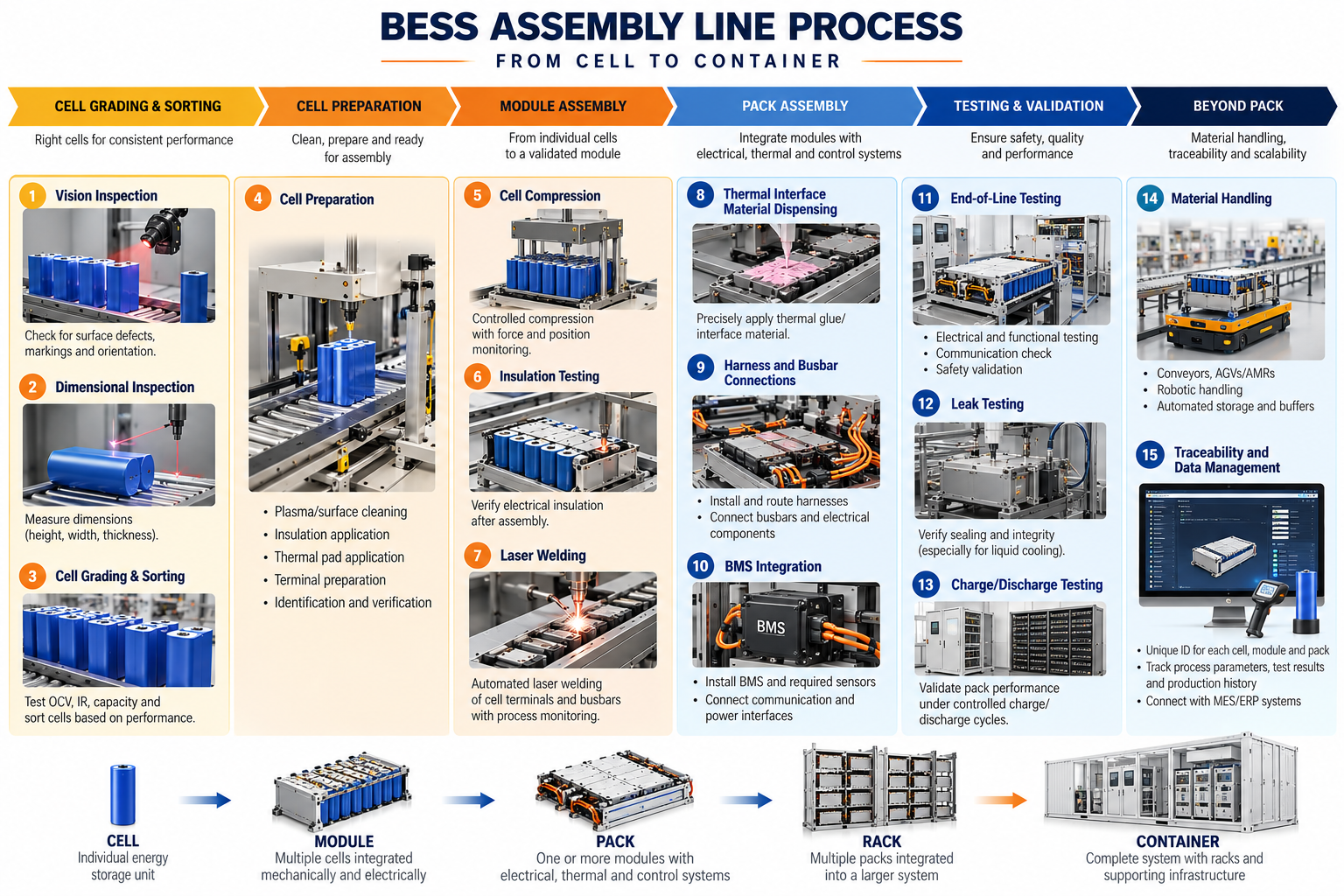
However, this is not necessarily one continuous conveyorized process. Modern battery factories can combine automated workstations, robotic systems, conveyors, AGVs, AMRs, buffers and inspection stations to create a flexible manufacturing ecosystem.
The architecture of the line ultimately depends on the architecture of the battery itself.
What Does a Battery Assembly Line Consist Of?
A typical BESS assembly architecture can be divided into several major stages:
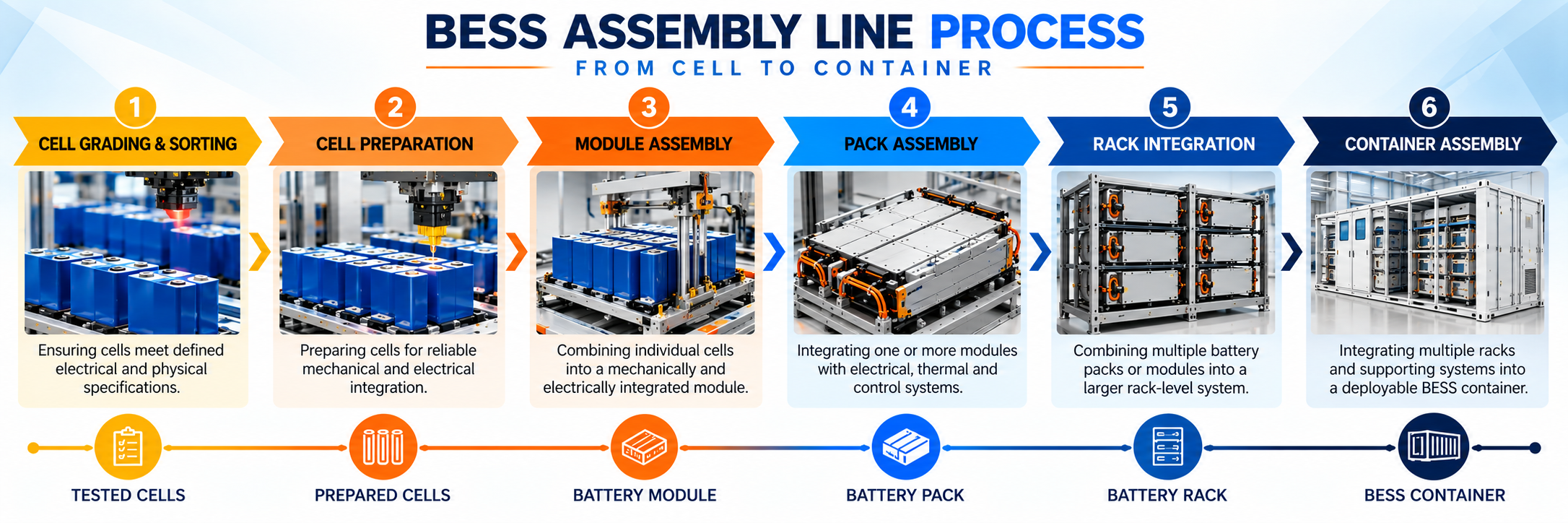
At every stage, testing and traceability help ensure that the product moving forward meets the required specifications.
1. Cell — The Building Block
A battery cell is the fundamental electrochemical unit that stores electrical energy. Cells are available in formats such as cylindrical, prismatic and pouch.
Before assembly, cells are typically inspected, tested and sorted based on parameters such as capacity, voltage, internal resistance and physical dimensions. This helps ensure consistency in the cells used for further assembly.
Cell = The basic energy-storage unit
2. Module — Cells Combined
A battery module is created by combining multiple cells into a mechanically and electrically integrated unit.
Cells are positioned, connected and secured together, with components such as busbars, insulation, compression systems and temperature sensors incorporated depending on the design.
Module = Multiple cells assembled into one unit
3. Pack — Modules Integrated
A battery pack brings one or more modules together with the electrical, thermal and control systems required for operation.
A pack can include modules, busbars, harnesses, sensors, thermal management components, protection devices and Battery Management System (BMS) interfaces.
Pack = Modules + electrical, thermal and control systems
4. Rack — Packs Organized into a Larger System
A battery rack combines multiple battery packs or modules into a larger structural and electrical assembly.
Racks provide the framework for connecting and managing multiple battery units and form an important building block of a larger BESS.
Rack = Multiple packs/modules integrated into a larger system
5. Container — Multiple Racks Integrated
A BESS container houses multiple battery racks along with the supporting systems required for safe and reliable operation.
Depending on the system architecture, this can include cooling systems, control cabinets, electrical protection, sensors, fire-safety systems and communication infrastructure.
Container = Battery racks + supporting infrastructure
6. BESS — The Complete Energy Storage System
A Battery Energy Storage System (BESS) brings the battery container together with the systems needed to operate and connect the stored energy to its intended application.
A complete BESS can include:
- Battery systems
- Battery Management System (BMS)
- Power Conversion System (PCS)
- Energy Management System (EMS)
- Thermal management
- Safety and fire protection
- Electrical infrastructure and controls
Each level increases the scale and functionality of the system—from a single energy-storage unit to a complete, deployable energy-storage solution
Behind this simple progression is a highly engineered manufacturing process involving precision assembly, testing, automation, material handling and traceability at every stage.
Where Patil Automation Limited Comes In
This is where the architecture of the battery and the architecture of the manufacturing line need to come together.
Patil Automation Limited (PAL) designs and delivers customized automation solutions for battery and BESS manufacturing, including cell processing, module and pack assembly, material handling, testing, traceability and container-level integration. Patil Automation Ltd.
Rather than forcing a standard line onto every customer, PAL’s approach is to build the automation around the product architecture, production capacity, process requirements and future scalability.
PAL’s BESS automation ecosystem can include:
Cell Sorting
Automated OCV/IR grading, thickness checking and inspection.
Module Assembly
Cell handling, compression, insulation and controlled assembly.
Laser Welding
Automated busbar positioning and laser welding with process monitoring.
Pack Assembly
Thermal interface dispensing, harness connection, BMS integration and testing.
Material Handling
AGVs, AMRs, conveyors and automated storage solutions for controlled movement of battery assemblies.
Testing
Integrated electrical, functional, EOL and leak-testing solutions.
Traceability
Connecting production data across machines and stages to create complete manufacturing visibility.
Container Assembly
Customized container layouts, heavy-payload handling, control cabinet installation and system-level testing.
PAL’s published BESS solution specifically describes an end-to-end architecture from Cell to Container, including robotic cell sorting, module compression, busbar laser welding, modular pack lines, AGV/ASRS handling and container assembly.