Custom Automation vs Standard Machines: Which Is Right for Your Manufacturing Process?
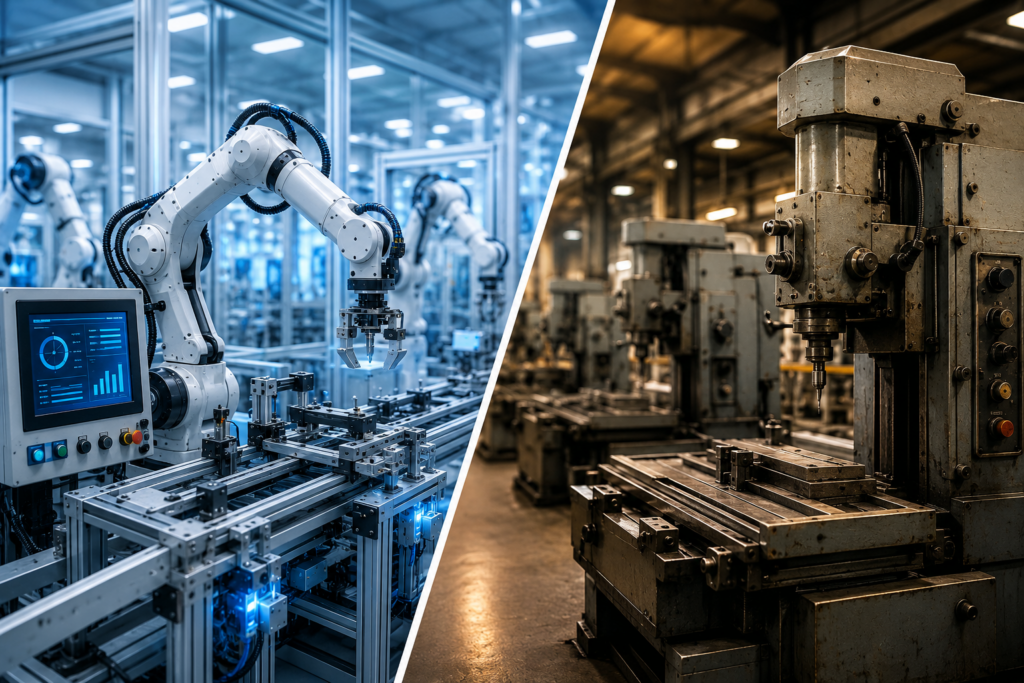
In today’s competitive manufacturing industry, companies are constantly looking for ways to improve productivity, reduce operational costs, and enhance product quality. One of the most important decisions manufacturers face is choosing between custom automation solutions and standard machines. Both options offer significant benefits, but selecting the right one depends on your production requirements, budget, operational goals, and future growth plans. In this guide, we’ll compare custom automation and standard machines to help you determine the best solution for your manufacturing process.
What Are Standard Machines?
Standard machines are pre-designed, ready-to-use pieces of equipment built to perform common manufacturing operations. These machines are widely used across industries and come with predefined features and specifications.
Benefits of Standard Machines
- Lower Initial Investment :
Because they are mass-produced, standard machines are generally more affordable than custom-built solutions. - Faster Installation and Deployment :
With minimal customization required, standard machines can be installed and operational quickly. - Proven Reliability :
These machines have been tested in various manufacturing environments, making them a dependable option. - Easy Maintenance and Support :
Replacement parts, technical support, and maintenance services are usually readily available.
Limitations of Standard Machines
- Limited flexibility for unique production requirements
- May require process adjustments to fit machine capabilities
- Can become restrictive as production demands evolve
What Is Custom Automation?
Custom automation involves designing and building machinery or automated systems specifically tailored to your manufacturing process. These solutions are engineered to meet exact production requirements and operational goals.
Benefits of Custom Automation
- Designed for Your Process :
Custom automation is built around your workflow, ensuring seamless integration and optimal performance. - Increased Efficiency :
By eliminating unnecessary steps and reducing manual intervention, custom systems improve productivity and consistency. - Scalability for Future Growth :
Custom solutions can be designed with future expansion and production increases in mind. - Competitive Advantage :
Unique automated systems can improve product quality, reduce costs, and differentiate your business from competitors.
Limitations of Custom Automation
- Higher upfront investment
- Longer design, engineering, and implementation timeline
- Specialized maintenance and technical expertise may be required
Key Factors to Consider When Choosing Between Custom Automation and Standard Machines
1. Production Volume
Standard Machines: Ideal for low to moderate production volumes.
Custom Automation: Best suited for high-volume manufacturing operations where efficiency gains can generate significant returns.
2. Product Complexity
Standard Machines: Effective for simple, repetitive production tasks.
Custom Automation: Better suited for complex products, multiple product variations, or specialized manufacturing processes.
3. Budget and Return on Investment (ROI)
Standard Machines: Lower initial cost makes them attractive for startups and smaller manufacturers.
Custom Automation: Although more expensive upfront, long-term savings through improved efficiency often deliver a higher ROI.
4. Flexibility and Adaptability
Manufacturing processes evolve over time. Custom automation systems can be designed to accommodate future modifications, while standard machines may have limited flexibility.
5. Integration with Existing Equipment
Custom automation can seamlessly integrate with existing production lines, software systems, and workflows. Standard machines may require operational adjustments or additional equipment to achieve compatibility.
When Should You Choose Standard Machines?
Standard machines may be the right choice if:
- You need a quick and cost-effective solution
- Your production process is straightforward and consistent
- You are launching a new product line and want to minimize investment risk
- Your manufacturing requirements align with standard equipment capabilities
When Is Custom Automation the Better Choice?
Custom automation is often the best option when:
- Your manufacturing process involves unique or complex requirements
- You want to maximize efficiency and reduce waste
- Production volumes are high enough to justify automation investments
- Long-term scalability and operational flexibility are business priorities
- You need seamless integration with existing manufacturing systems
The Hybrid Approach: Combining Standard Machines and Custom Automation
For many manufacturers, the ideal solution is a combination of both approaches.
A hybrid manufacturing strategy may involve using standard machines for common operations while implementing custom automation for specialized processes. This approach helps balance cost-effectiveness, flexibility, and productivity.
Final Thoughts
Choosing between custom automation and standard machines is not a one-size-fits-all decision. The best solution depends on your production goals, operational challenges, budget, and long-term growth strategy.
If your priority is affordability and rapid implementation, standard machines may be the ideal choice. However, if you are focused on maximizing efficiency, improving production quality, and building a scalable operation, custom automation can provide a significant competitive advantage.
Before making a decision, conduct a thorough assessment of your manufacturing process and consult automation experts who can recommend the most effective solution for your specific needs.
Ready to Optimize Your Manufacturing Process?
Whether you’re considering standard equipment, custom automation, or a hybrid solution, choosing the right manufacturing technology can significantly improve productivity, reduce costs, and position your business for long-term success.
When Should You Choose Standard Machines?
Standard machines may be the right choice if:
- You need a quick and cost-effective solution
- Your production process is straightforward and consistent
- You are launching a new product line and want to minimize investment risk
- Your manufacturing requirements align with standard equipment capabilities
When Is Custom Automation the Better Choice?
Custom automation is often the best option when:
- Your manufacturing process involves unique or complex requirements
- You want to maximize efficiency and reduce waste
- Production volumes are high enough to justify automation investments
- Long-term scalability and operational flexibility are business priorities
- You need seamless integration with existing manufacturing systems
The Hybrid Approach: Combining Standard Machines and Custom Automation
For many manufacturers, the ideal solution is a combination of both approaches.
A hybrid manufacturing strategy may involve using standard machines for common operations while implementing custom automation for specialized processes. This approach helps balance cost-effectiveness, flexibility, and productivity.
Final Thoughts
Choosing between custom automation and standard machines is not a one-size-fits-all decision. The best solution depends on your production goals, operational challenges, budget, and long-term growth strategy.
If your priority is affordability and rapid implementation, standard machines may be the ideal choice. However, if you are focused on maximizing efficiency, improving production quality, and building a scalable operation, custom automation can provide a significant competitive advantage.
Before making a decision, conduct a thorough assessment of your manufacturing process and consult automation experts who can recommend the most effective solution for your specific needs.
Ready to Optimize Your Manufacturing Process?
Whether you’re considering standard equipment, custom automation, or a hybrid solution, choosing the right manufacturing technology can significantly improve productivity, reduce costs, and position your business for long-term success.